- Irg's Athletes in Business Notes
- Posts
- Why Elite Athletes Are Uniquely Positioned for Careers in AI and Web3
Why Elite Athletes Are Uniquely Positioned for Careers in AI and Web3
Conventional career advice fails retired athletes because it ignores how they actually function. A structured alternative is showing promise.

Irg Torben Bührer
January 12, 2026
KEY POINTS
The retirement crisis for elite athletes is structural, not psychological. When the tightly engineered performance environment of sport disappears, athletes lose the operating system that converted effort into progress—not their capability or discipline.
AI and Web3 function as performance environments. These domains reward rapid iteration, visible output, and learning velocity over formal credentials, creating conditions structurally similar to elite sport and currently open to non-traditional backgrounds.
The Future Athlete Operating System (FAOS) reconstructs athletic performance conditions for career transition.Through fixed timeboxes, forced narrowing, gated progression by output, and early reality contact, the framework accelerates exposure to market feedback—producing clarity in weeks rather than months.
👉 Bonus: Below you will find five ChatGPT prompts that you can use to develop your expertise in this area.
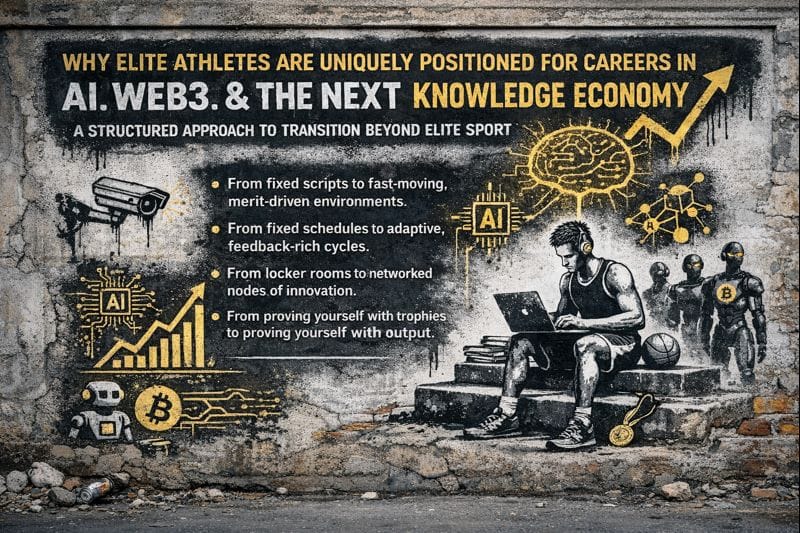
Years ago, I sat across from a former professional basketball player who had just spent six months “exploring his options.” He’d attended networking events, taken online courses, and had coffee with dozens of people offering advice. He was well-informed, well-connected, and completely paralyzed.
“Everyone tells me to find my passion,” he said. “But in basketball, I didn’t find my passion first. I had structure, feedback, and standards. The passion came from getting better every day.”
That conversation crystallized something I’d been observing: elite athletes don’t struggle after sport because they lack discipline or intelligence. They struggle because the performance environment that structured their lives disappears overnight, and conventional career transition wisdom is fundamentally misaligned with how they actually operate.
Since then, I’ve been testing a different approach with former professional athletes across multiple sports. The results have challenged much of what we think we know about athletic transitions—findings I’ve now compiled in a white paper titled “Why Elite Athletes Are Uniquely Positioned for Careers in AI, Web3, and the Next Knowledge Economy—A structured approach to transition beyond elite sport.”
The Structure Problem
During their competitive careers, elite athletes operate within what I call a tightly engineered performance environment. Time is segmented into training blocks. Feedback arrives constantly through coaches, statistics, teammates, and competition results (Figure 1). Standards exist independently of self-assessment—you either made the team or you didn’t, won the match or you lost.
Figure 1

When that scaffolding vanishes, athletes retain their capabilities but lose the operating system that converted effort into measurable progress. What remains is capability without an environment to translate it into outcomes.
The standard advice—explore your interests, take time to figure things out, build your personal brand, keep your options open—assumes that clarity precedes structure. For elite performers, I’ve observed the reverse: clarity emerges through constraint, not contemplation.
This isn’t a psychological insight. It’s a structural observation. The problem isn’t identity crisis; it’s environmental collapse.
Why AI and Web3
I focus specifically on artificial intelligence and Web3 because these domains function as performance environments in ways that traditional corporate careers do not.
Both fields offer rapid feedback cycles. In AI, models are iterated continuously. Products are deployed, observed, and revised in short cycles. In crypto markets, decisions receive immediate market response. This restores a cognitive rhythm familiar to athletes trained to calibrate themselves daily against external standards.
Credentials matter less than visible output. Code repositories, research memos, product analyses, and public reasoning carry more weight than résumés. Reputation builds incrementally through exposure to critique, not institutional gatekeeping. Athletes whose primary currency was performance rather than pedigree recognize this environment immediately.
There’s also a practical timing consideration. These domains currently value non-traditional backgrounds because credentialism hasn’t fully solidified. I watched this window close in finance, consulting, and venture capital. AI and Web3 are still in the open phase, but this won’t last indefinitely.
In AI specifically, the learning tools and working tools are identical. To learn about AI systems, you use AI systems. This collapses the separation between education and application—exactly how athletes are trained to operate. Every hour spent learning simultaneously builds fluency with tools that practitioners use daily.
The Future Athlete Operating System
The framework I’ve developed—the Future Athlete Operating System, or FAOS—reconstructs key conditions of elite sport through five principles:
Fixed timeboxes: Eight to twelve weeks for initial testing. No open-ended exploration. I treat this as a performance season, not a journey of self-discovery.
Gated progression: Advancement requires concrete outputs—a written analysis, a public positioning statement, evidence of external response. Not effort. Not enthusiasm. Something that exists in the real world that can be evaluated by others.
Forced narrowing: Participants must commit to a specific path within three weeks. “Exploring both options” consistently emerged as the single biggest blocker of progress. Maintaining optionality delays feedback, which stalls learning.
Proof artifacts over credentials: Participants produce three to five substantial pieces of work—research memos, ecosystem analyses, investment theses. In these domains, the artifact is the credential.
Early reality contact: Participants must expose their work to external evaluation within three to four weeks, before confidence calcifies around incorrect assumptions. Readiness emerges from engagement with reality, not insulation from it.
The approach is deliberately uncomfortable. I prioritize signal over protection, speed over polish.
Early Results
Between late 2024 and the third quarter of 2025, I ran seven pilot cycles with former professional athletes from basketball, football, handball, American football, volleyball, and swimming. Several consistent patterns emerged across the cohort.
The sample size is too small for confident generalization. But the framework appears to accelerate reality exposure by several months compared to unstructured exploration. Three athletes from the initial cohort remain actively engaged. Two have produced more than eight public artifacts. Three have transitioned from unpaid output to exploratory paid engagements.

The Infrastructure Behind the Work
To support the framework, We’ve developed several experimental AI-powered tools and platforms that emerged from direct observation of how athletes behave under constraint.
The Future Athlete OS Enforcer functions as an automated referee, checking whether participants have narrowed their focus, produced required artifacts, exposed work to external evaluation, and updated their approach based on feedback. It enforces process compliance without judging final quality—markets handle that evaluation. The system makes avoidance impossible while leaving all substantive judgments to external reality.
The Crypto Athlete Collective creates a constrained learning environment where athletes study crypto concepts alongside market participants, present analyses, receive critique, and adjust their understanding based on market response. It’s designed to compress the gap between theory and practice.
We’ve also built ProCurator AI, a personal intelligence tool that compresses information into decision-relevant artifacts, and ProTwin AI, a controlled interface for guided expertise that forces clarity and drives next actions rather than offering open-ended reassurance*. Both tools aim to reduce cognitive overhead while preserving individual judgment—a balance critical for maintaining the athlete’s agency while accelerating their learning curve.
These systems aren’t finished products (yet). They’re experimental infrastructure for testing hypotheses about what conditions enable effective transitions.
Furthermore, we have created freely accessible custom GPTs that always aim to promote personal development in a very concrete way and are not limited to being a sparring partner, but are designed to encourage action and results. This is entirely in line with the needs of athletes who are accustomed to taking action, learning from it, and thus progressing and achieving their goals.
The Passion Question
Elite athletes possessed all-encompassing devotion to their sport. That intensity cannot and should not be expected to transfer to other domains. I don’t assume athletes will feel the same fire for AI or Web3 that they felt for competition.
Instead, I’ve observed that sustained engagement can emerge from structure, competence development, and visible progress, even when passion is less immediate or intense. The framework creates conditions for genuine interest to develop through execution, not through attempting to recreate an irreplaceable experience.
Picasso said it better: “Inspiration exists, but it has to find you working.”
—
*Implementation example (internal strategist twin): A pilot ProTwin (IrgPT), built to assess whether structured, domain-specific dialogue can expose an athlete’s assumptions or the opportunities/options to be reduced more quickly and thus enable faster development of their projects than human back-and-forth focused on loss of identity and is purely supportive without a clear goal.
5 PROMPTS THAT ATHLETES CAN USE TO DEVELOP AND BUILD EXPERTISE
Analyze [specific AI product/Web3 protocol] like you're scouting an opponent. What's their edge? Their weaknesses? Where are the exploitable gaps? Write 500 words with a clear verdict: overvalued, undervalued, or fairly valued.
Take one concept from your sport (zone defense, periodization, game theory) and explain how it applies to [AI training / crypto trading / DAO governance]. Write 400 words as if teaching someone who's never played your sport.
Choose one technical concept that confused you. Explain it to a 12-year-old athlete in 300 words. If you can't make it simple, you don't understand it yet. Publish it and invite critique.
Identify the dominant narrative in AI or Web3 right now. Write 500 words arguing why it's incomplete or wrong. Support with evidence. Test if you're thinking independently or just echoing others.
Document one real decision you're facing. Write: (1) What you know (2) What's missing (3) Your assumptions (4) What would change your mind (5) Your decision. Revisit in 4 weeks and analyze what you got right and wrong.
👉 Please get in touch for more prompts or the best of our Custom GPTs to use in your situation.
What This Means
These ideas are hypotheses under active evaluation, not polished conclusions. Critical questions remain about scalability and long-term outcomes. The framework currently advantages athletes with sufficient financial runway to engage without immediate earnings—a limitation I’m still working to address.
What I do know: conventional transition support often prioritizes reflection over execution and reassurance over signal. This approach, while well-intentioned, removes precisely the constraints elite performers need to function effectively. Structure doesn’t limit possibility for individuals trained under structure. Structure enables possibility.
Ultimately, this isn’t about helping athletes find themselves. It’s about helping them reconstruct the operating system that made elite performance possible in the first place—just pointed in a new direction.
👇
I really appreciate you reading my note today.
Peace,
Irg
Irg’s work is provided for informational purposes only and should not be construed as legal, business, investment, or tax advice. You should always do your own research and consult advisors on these subjects. This work may feature assets and entities in which the author has invested.
🙏 Thanks for reading Irg's Athletes in Business Notes! Subscribe for free to receive new notes and support my work.
© 2026 Athletes in Business Notes by Patparius GmbH